





LumeAgentEnterprise AI Agent Governance Platform

Move agents beyond pilots and into real work

Bring roles, knowledge, tools, permissions, audit and budgets into one system. Give business teams room to act, give IT control, and keep every execution traceable.

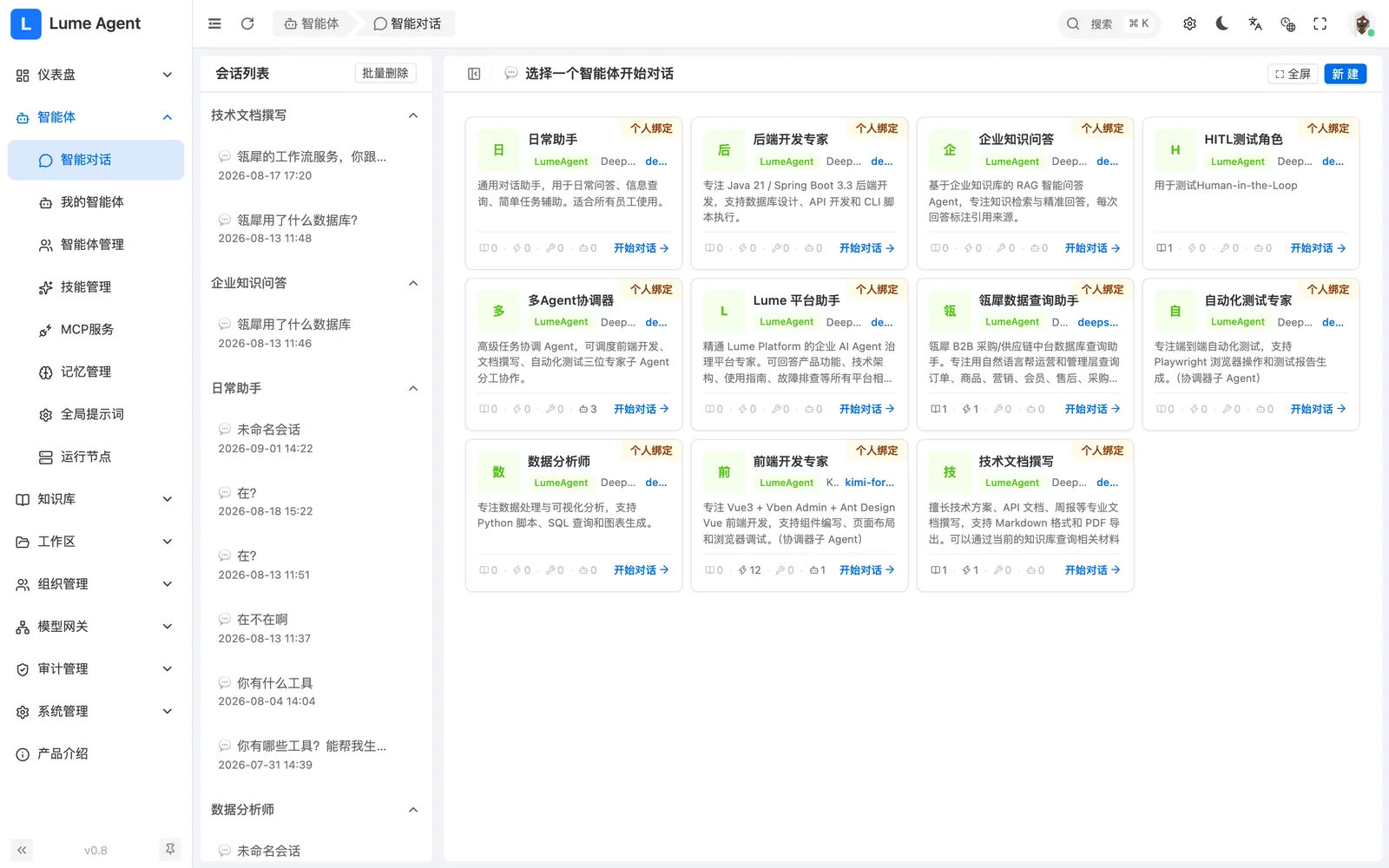
LumeAgent session screen: a conversation list on the left and an agent card grid headed "select an agent to start chatting" on the right
01 · What blocks it

If these six problems remain, agents stay stuck in pilot mode

What blocks rollout is rarely the model alone. It is fragmented ownership of permissions, knowledge, tools, accountability and cost.

Nobody can say who may use an agent, or which data it may touch

Permissions sit across business systems and manual approvals, so after launch only the person who configured the agent can say who may use it or which data it can reach.

Answers cannot be checked against a source

Answers read well, but nothing says which document they came from; checking means going back to the source, or trusting the model.

Every conversation starts from zero, so experience never accumulates

Background, definitions and earlier conclusions all have to be restated in a new session; change the person or close the session and the experience resets.

There is no visibility into how many tokens were spent, or by whom

The bill arrives at month end and only the total has moved; which person, application or task spent it is anyone's guess.

Once an agent has acted, the trail cannot be reconstructed

After an incident the only trace is a chat log: who authorised the action, what the agent read or wrote, and which document it relied on do not line up.

Nothing stops an agent from performing a dangerous operation

Bulk deletes, outbound sends and payment operations can run as ordinary steps, with nothing pausing to confirm first.

02 · How it is solved

LumeAgent: One request. Six governance checkpoints.

Every call takes the same path: identity, permissions, knowledge boundary, tool scope and budget are settled as the request arrives.

  1. 01Request intakeIdentity check

    First, confirm who is making the request.

  2. 02Invocation frameworkRole routing

    Then decide which role should take it on.

  3. 03Capability assemblyScoped access

    Prepare only the capabilities this request may use.

  4. 04Governance InjectionPolicy carried

    Run with permissions and policies attached.

  5. 05Governance and observabilityBlocked & logged

    Block dangerous actions and log the full process.

  6. 06Standardized resultUsage traced

    Return the result, its evidence and usage for the call.

03 · What holds it up

Four layers that govern every business call

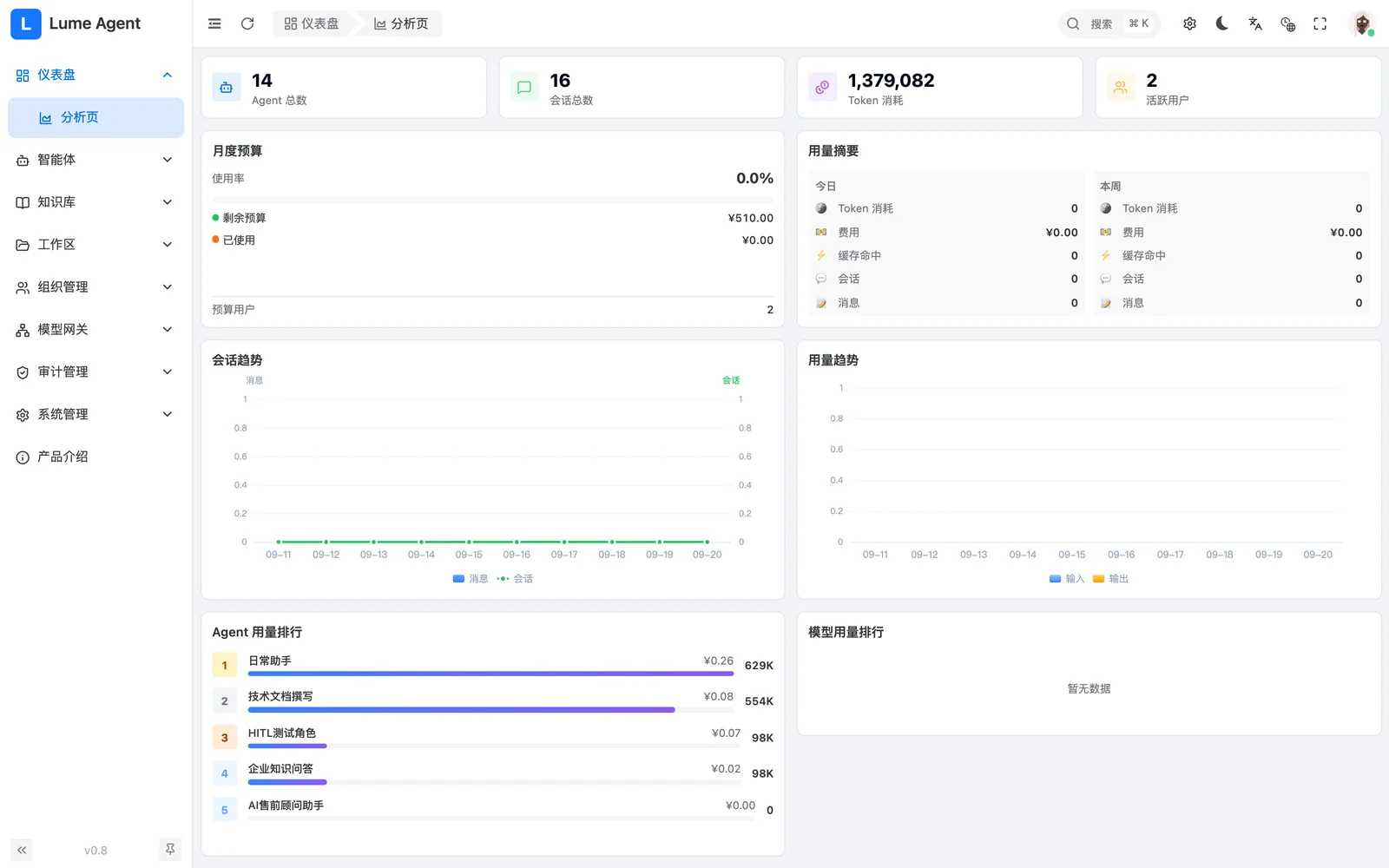
Who owns each step is fixed by the four layers. Business enters at the top layer: an employee asks a question, a business system makes a call. The middle two layers draw the boundaries and run the governance: who may use which data, models and tools, retrieval that returns only what permissions allow, dangerous actions stopped, and a full trail. Data and knowledge stay on your own infrastructure.

01

Access

Employees ask questions directly, business systems call directly

Console for employees and adminsSessions / approvals / configuration / dashboards
AI gatewayCompatible API for business systems, with its own keys, rate limits and budgets
03

Agent runtime

Answers carry their sources, and every step leaves a trail

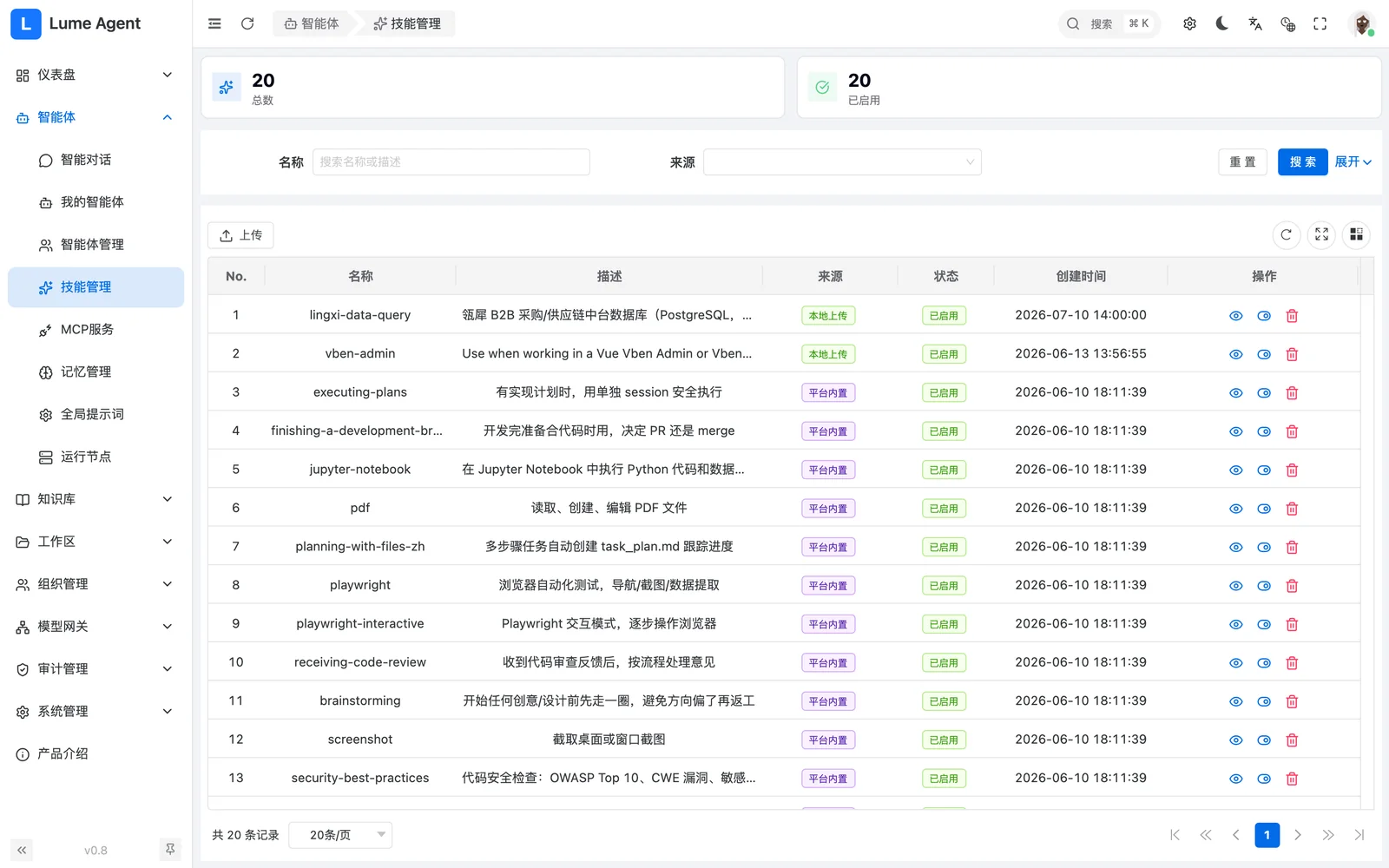
Role assemblyA session is assembled by role first: model, skills, tools and knowledge scope
Governance middleware chainSystem prompt / persona and org context / retrieval / sensitive words / memory / compaction / audit
Tools and MCPBuilt-in tools and MCP servers, released by the role whitelist
Session stateSession metadata and approvals live in shared storage, not on one machine
Sandboxed executionFiles and commands run in a dedicated container, with capabilities dropped and privilege escalation denied
04

Data and infrastructure

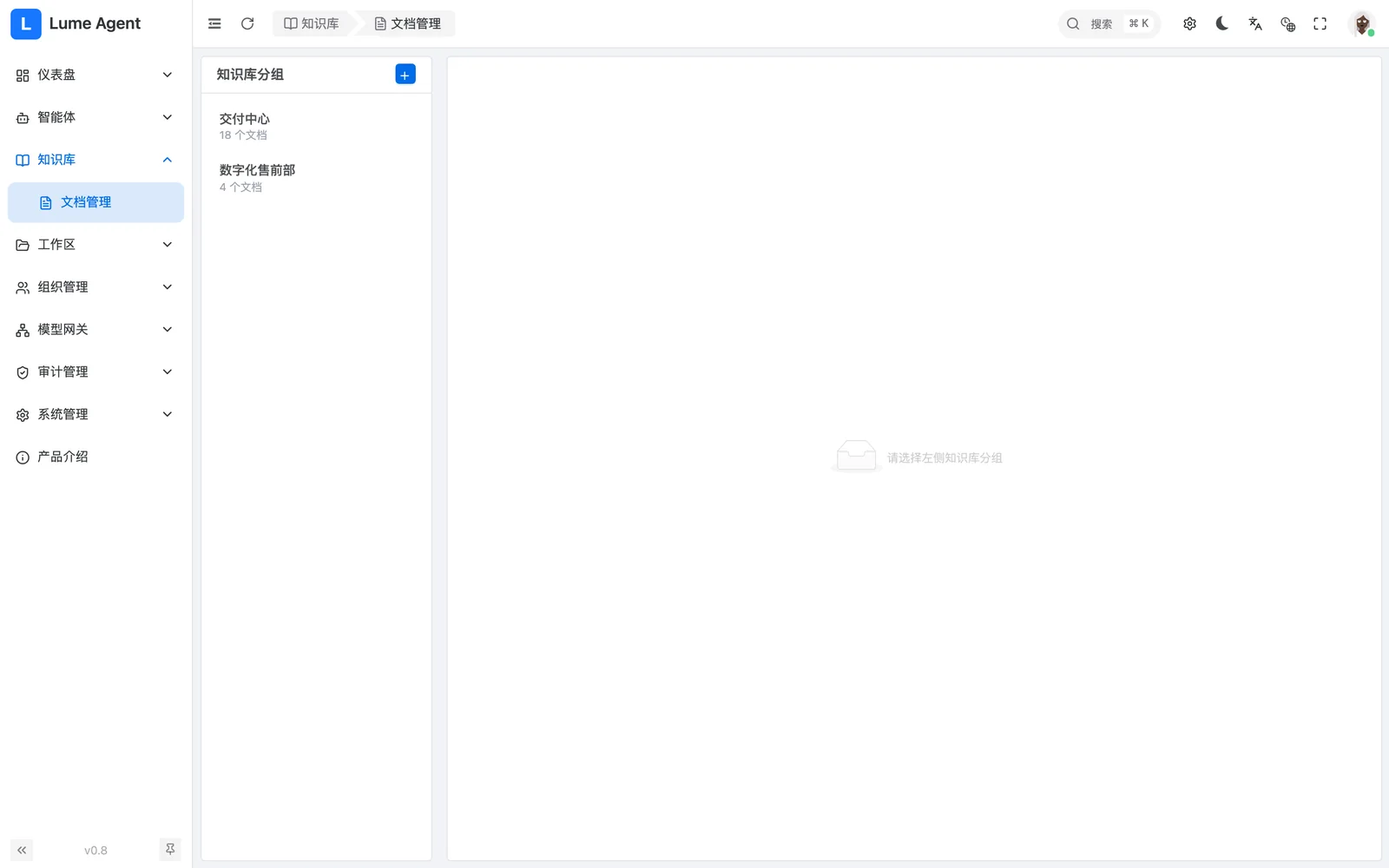
Data and knowledge stay on your own infrastructure

PostgreSQL + pgvector (or Milvus)Business data / knowledge chunks / vector index
RedisSession metadata / rate limits / blacklists / approval state
MinIOObject storage for files and workspaces
DockerPer-user sandbox containers

Models and enterprise systems

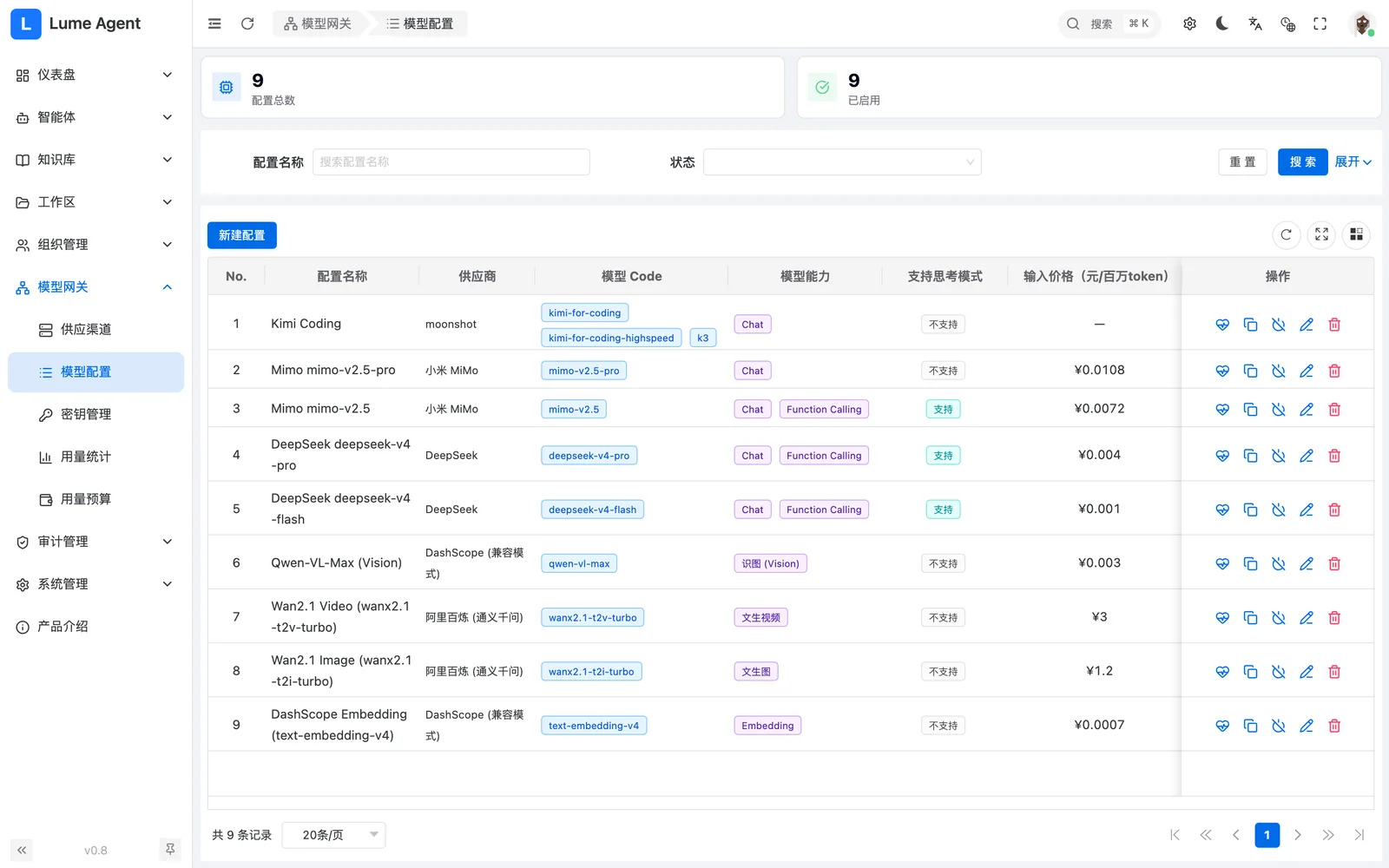
Supports multiple model providers, and enterprise system integration

Model provider integrationDeepSeek, Volcano Engine, OpenAI-compatible and other providers
Enterprise system integrationERP, CRM and OA systems, connected through MCP servers

Every service is deployed as a container, so the platform can run inside your own environment.

05 · Inside a real scenario

Start with one high-frequency workflow and put agents to work

How the six capabilities work together inside one scenario: where the work gets stuck, which boundaries cannot be crossed, and what actually changes in the work.

LumeAgent / Workspace
Enterprise workspaceYour assistant
Ready

Knowledge assistant

I am travelling to Shenzhen next week. What should I watch out for on the expense claim?

LumeAgentAGENT

The documents and allowances depend on the destination city and your grade. Should I work it out for your grade, or list the general requirements first?

Work it out for my grade and ShenzhenShow the general list first

Work it out for my grade and Shenzhen.

LumeAgentAGENT
Understanding your request
Check permissionsSearch the travel policyApply city and grade rulesGround the answer

Worked out for your grade and the Shenzhen standard. The checklist and the sources are below.

Your travel expense checklist
Itinerary and trip approval01
Valid transport and hotel receipts02
Itemized expenses and supporting notes03
Allowance: by destination city and grade04
View sources
LumeAgentAGENT

Should I write this checklist into your personal workspace so you can check it again before the trip? Writing a record needs your confirmation.

Write it to my workspaceJust this answer

Write it to my workspace.

LumeAgentAGENT

Written to your workspace as you confirmed. The checklist keeps its source citations, so you can go back to the original text.

ActionWrite to workspace
VisibilityYou only
StatusCompleted

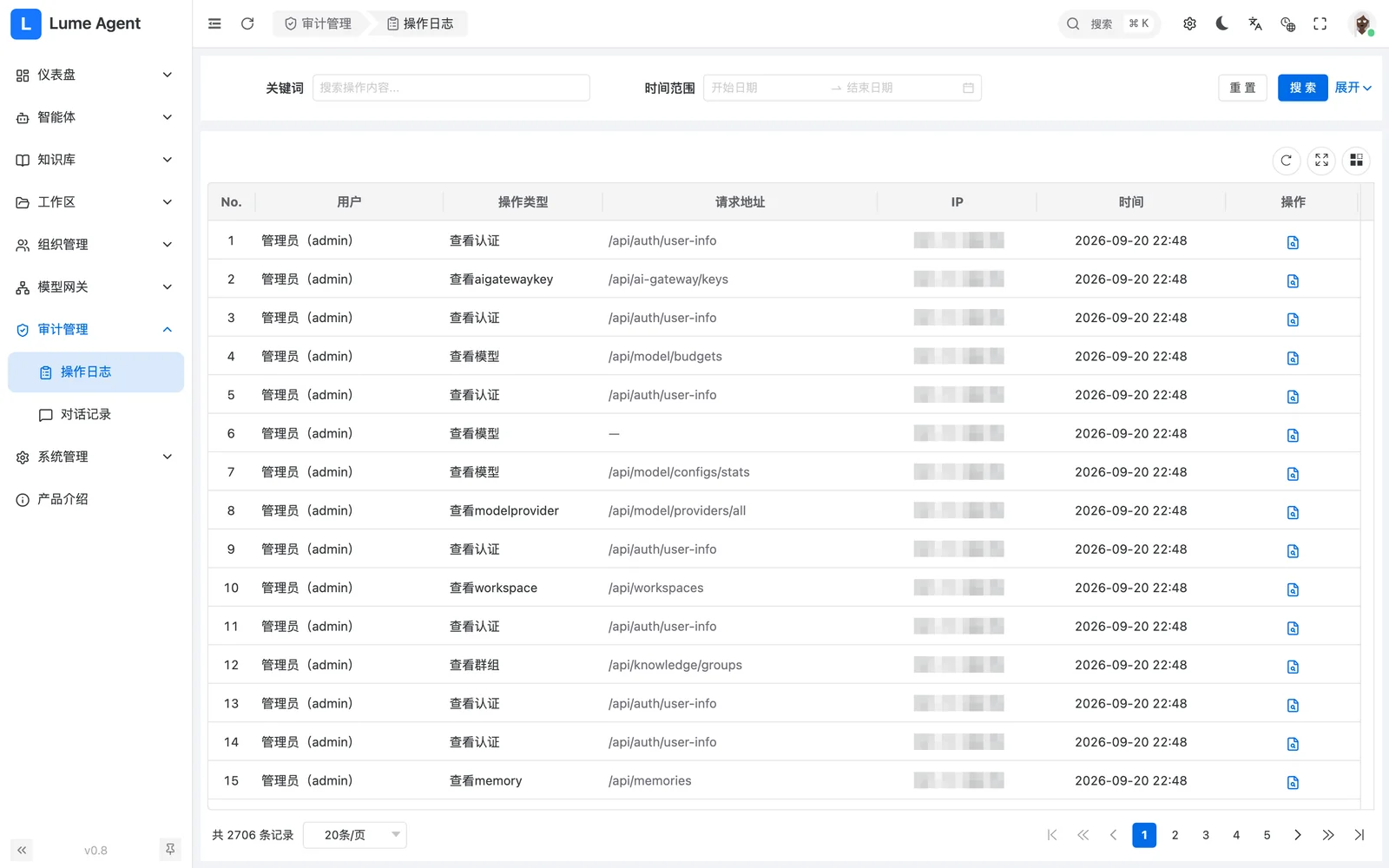
The action is recorded in the operation audit, traceable by person and time.

Within your permissions·Interactive demo · Sample data

The same policy is explained differently by different departments · Newcomers keep asking while experienced staff keep getting interrupted

  • Document visibility is scoped by department
  • Answers must trace back to the source text, not model memory
  1. 01Scope knowledge visibility by department and position, so retrieval surfaces only what the user may see
  2. 02Mark citation sources in answers; a click traces back to the passage
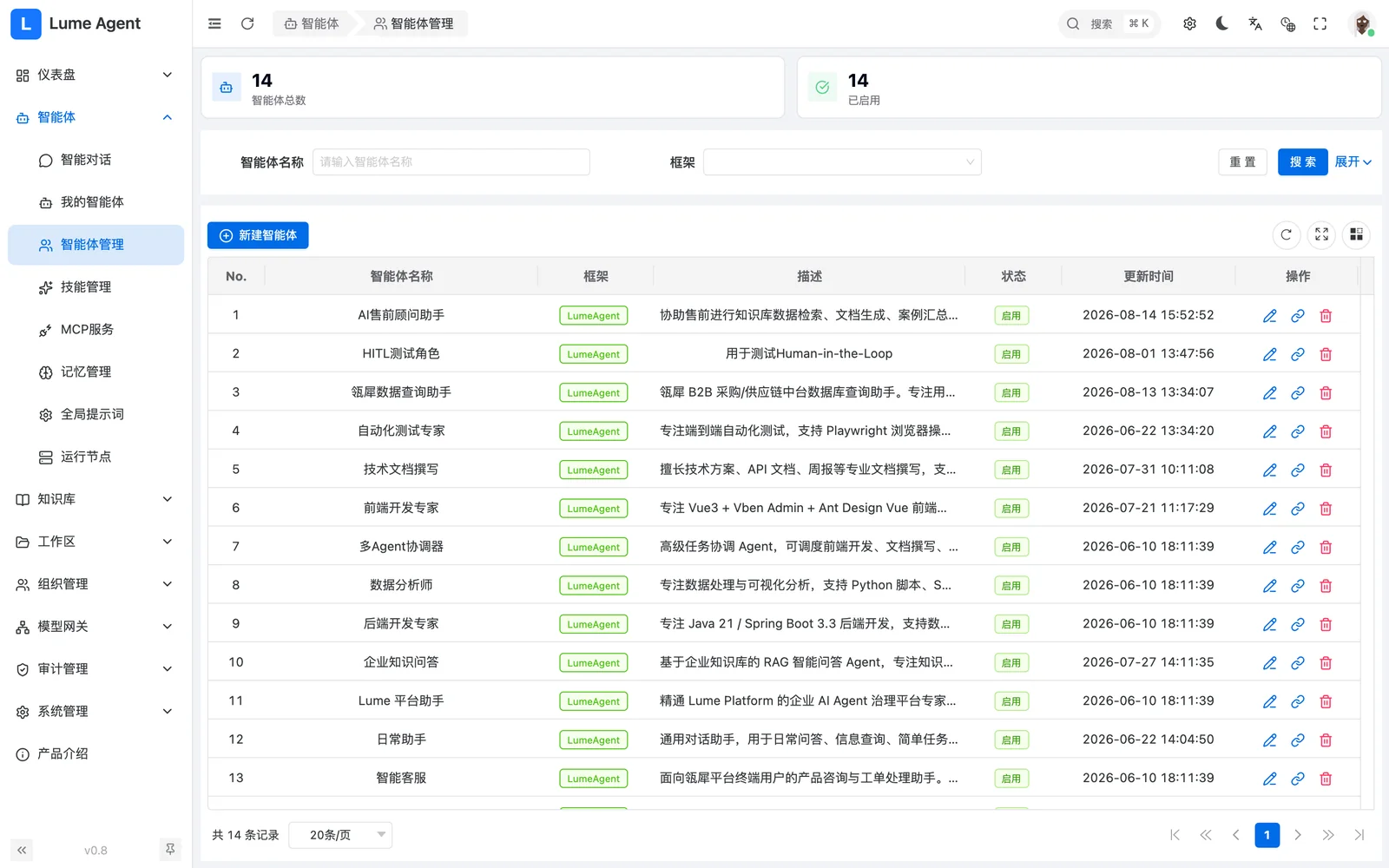
  3. 03Make "policy Q&A" an Agent Role anyone can claim, with visibility following the position
Explore

Policy questions no longer depend on who remembers.

06 · Results already delivered

Value already delivered, case by case.

What these scenarios produced on site: across government, energy, retail, banking, tendering, and culture and education.

Client names, people and business information in these cases have been anonymized.

Government operationsA provincial emergency-management authority

Document drafting moved from finding references, assembling structure and reformatting to supplying key facts and reviewing a draft.

Results
  • 4 hours50 minutes

    Drafting time per document
  • −70%

    Format and template rework
  • 90 min10 min

    Reference retrieval before sign-off
01The work before

Reference material sits across years of files, policies and precedents, while document type, format and wording are tightly controlled, so each document needs manual structure and repeated formatting.

02Delivery approach

The system retrieves material under document templates and formatting rules and produces a structured first draft; people supply the critical facts and approve the document before export.

03What changed

The system handles retrieval, structuring and formatting, while people concentrate on fact checking and final approval.

Supporting capabilities
  • Agent roles and skills
  • Knowledge Base RAG
  • Document parsing and multimodal input
  • Audit trail
Delivery path

Four steps to put one business scenario live

From one scenario to go-live, every step carries a fixed duration, a concrete deliverable, and the time we need from you.

  1. 1–2 weeks

    Scenario and governance assessment

    Confirm which business problem to solve, and the permissions, audit and data boundaries that come with it.

    DeliverablesScenario feasibility assessment and a prioritised recommendation

  2. 2–4 weeks

    Roles, knowledge and integration

    Define Agent Roles, bind knowledge bases and skills, set the visibility scope, and complete the integration with internal systems such as ERP, CRM and OA.

    DeliverablesRole and knowledge configuration checklist and a runnable demo environment

  3. 4–6 weeks

    Build, test and go live

    Build the agent architecture, and develop its dialogue and decision logic; then test and tune it against real scenarios and go live; administrators and business owners are trained separately.

    DeliverablesA live agent system, training material and an operations handbook

  4. Ongoing

    Continuous operation

    Keep adjusting role configuration and budgets based on usage and audit data, and extend the work to new scenarios.

    DeliverablesOperations reports and optimization recommendations

First scenario live in 8–12 weeks; later scenarios reuse the foundation and ship in 2–4 weeks.

Service and delivery

Delivery does not stop at handover

Who owns each stage along that path: from scenario diagnosis to year-round operation, every stage has a named owner and a concrete output.

  • Diagnose before you invest

    The first 1-2 weeks do one thing: make this scenario clear -- whether it is worth building an Agent for, and where its boundaries are. You get the conclusion first; then we discuss the plan and the quote; all it takes from you is one business interview.

  • Something runnable every two weeks

    During development we deliver a runnable version every two weeks, so progress stays visible; scope changes are resolved inside the iteration rather than by verbal promise.

  • Still here after go-live

    We deliver the complete agent system, technical documentation and training, and an operations support plan. After go-live we provide a year of continuous operation: effect monitoring, capability optimization and scenario expansion.

What the service covers

  • Custom development

    Architecture design for a single agent or a collaborating multi-agent system, dialogue and decision logic development, and deep integration with business systems.

  • System integration

    Connecting ERP, CRM and OA systems, plus API, plug-in and workflow toolchain design.

  • Testing and tuning

    Scenario-based testing and tuning, retrieval accuracy improvement and fallback design for exception paths.

Deployment options

  • Public cloud

    Fast to launch and billed on demand, suited to validating before scaling.

  • Private cloud

    Data stays inside your corporate network and meets financial and government compliance requirements.

  • On-premise

    Fully offline, running independently inside your own network.

Bring your real scenario and we will start with a scenario and governance assessment.

Run a diagnosis on my scenario

What you will want to know before going live

Clarify deployment, data, integration and operating boundaries before taking a real scenario forward.

Will an agent call the wrong tools, or run the wrong commands?

Tool authorization is per role: only tools on the role's allow list are called. When a sensitive tool is requested, execution pauses for a human to approve or reject. Dangerous commands run inside Sandbox Isolation, with capabilities trimmed and privilege escalation forbidden.

Can data leave our network?

The platform supports private deployment: database, cache, object storage and vector retrieval all run in containers, so data and model calls stay inside the enterprise boundary.

When something goes wrong, can we reconstruct what happened?

Yes, actions and conversations inside the platform are traceable: the operation trail records who changed what, the conversation trail records content and usage, and sensitive information is masked before storage.

How long does it take to connect our internal systems?

The integration path we support today is MCP Server integration: connection health is visible, keys are stored encrypted, and authorization is tool-level. How a specific system is connected, and how long it takes, depends on its own interface and authentication method.

How do roles map to people?

An Agent Role is a capability template: identity prompt, skills, tool allow and deny lists, available models and visibility scope are configured once, then assigned by user, group or position. One user can hold several roles, so a change of position is a change of assignment.

Can the budget run away?

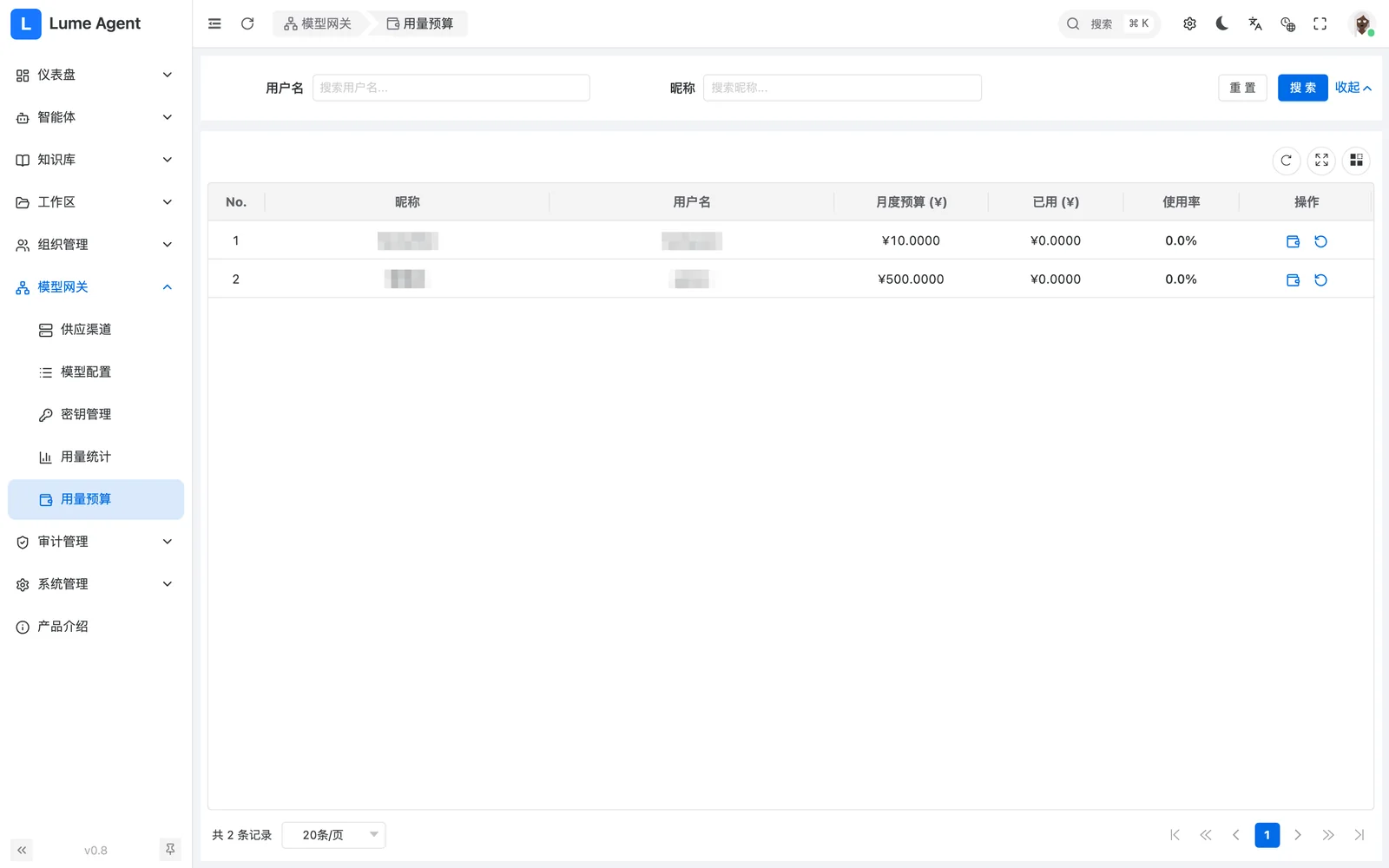
Billing uses each model's real unit price, budgets are deducted in real time, and calls are blocked at the limit; usage supports Cost Attribution by person, role and model.

Bring one real scenario. We will run it together.

In 30 minutes, we will assess whether your scenario fits an agent, what knowledge and systems it needs, and how permissions, audit and budgets should be set.

Bring my scenario to a demo